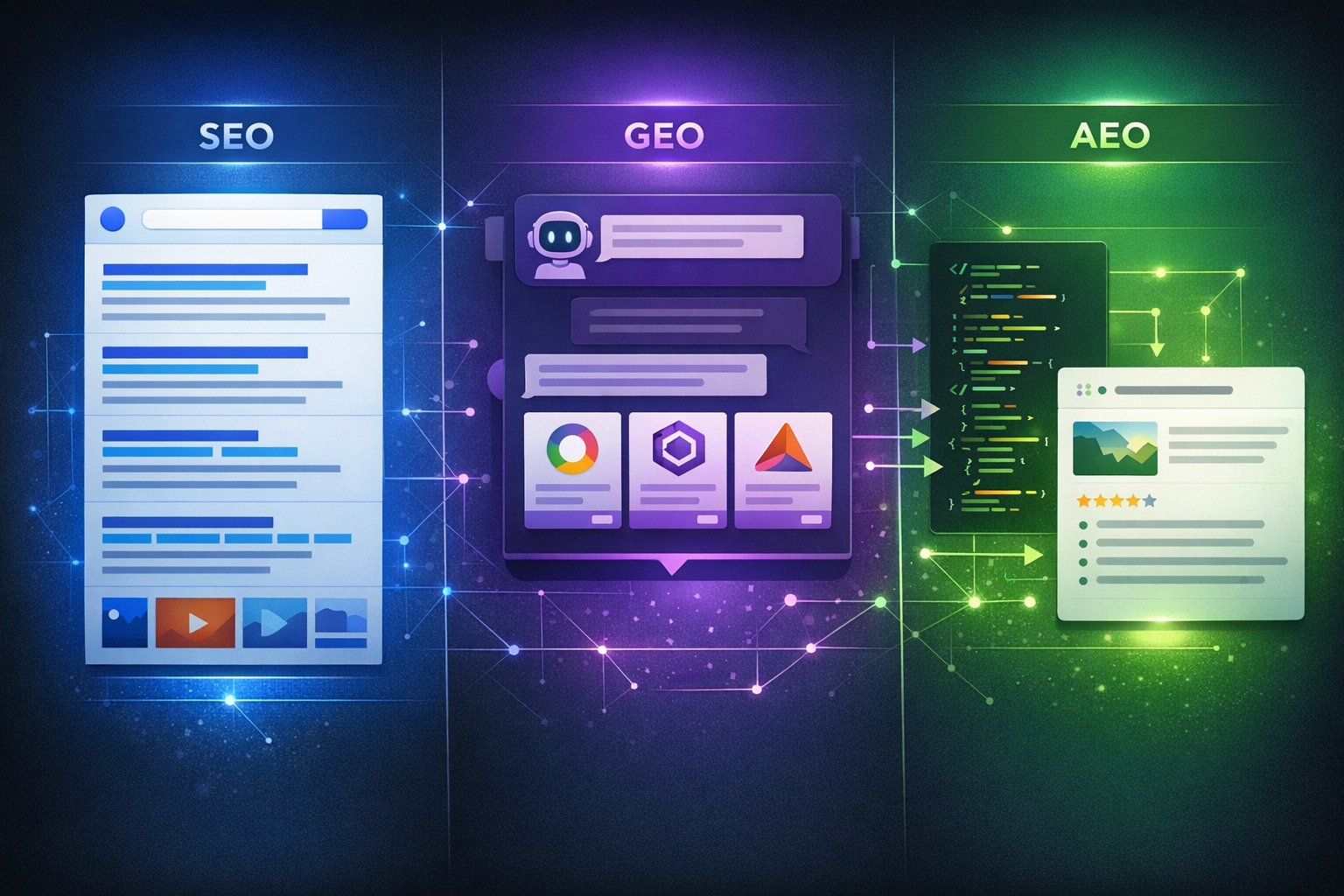
The fastest way to get cited by AI engines in 2026 is GEO (Generative Engine Optimization), because it directly targets how ChatGPT, Perplexity, and Gemini synthesize and recommend sources. AEO (Answer Engine Optimization) is the newest entrant, and SEO remains essential for Google’s traditional results. But confusing these three frameworks costs businesses time and money on strategies that target the wrong outcomes.
In April 2026, a group called “AI Search Engineers” launched a formal AEO framework, adding yet another acronym to the already crowded search optimization landscape. With ChatGPT hitting 900 million weekly active users and Google rebuilding its entire ad business for AI search, the stakes for picking the right framework have never been higher.
This article compares AEO, GEO, and SEO across methodology, target platforms, measurement, and practical results so you can stop guessing and start optimizing for what actually moves the needle.
What Is SEO (Search Engine Optimization)?
SEO is the oldest and most established framework. It optimizes web pages to rank higher in traditional search engine results pages (SERPs), primarily Google.
Core focus: Ranking positions, click-through rates, organic traffic from blue-link results.
Key techniques:
- Keyword research and on-page optimization
- Backlink building and domain authority growth
- Technical SEO (site speed, crawlability, structured data)
- Content optimization for search intent
Where it falls short for AI search: Google’s traditional SERPs and AI-generated answers operate on fundamentally different logic. A page ranking #1 for “best CRM software” may never appear in ChatGPT’s recommendation because AI engines prioritize entity consistency, source diversity, and direct answers over backlink profiles and keyword density.
SEO remains critical. Google still processes over 8.5 billion searches daily as of early 2026. But SEO alone no longer covers the full search landscape.
What Is GEO (Generative Engine Optimization)?
GEO targets how generative AI engines select, synthesize, and cite sources in their responses. The term was formalized in a Princeton/Georgia Tech research paper published in late 2024 and has since become the standard framework for AI visibility.
Core focus: Getting your brand or content cited/recommended by ChatGPT, Perplexity, Gemini, Claude, and other AI engines.
Key techniques:
- Answer-first content structure (first sentence directly answers the query)
- Entity consistency across multiple authoritative sources
- llms.txt deployment for AI crawler guidance
- Structured data (FAQ, Article, Organization schema)
- Multi-platform content distribution to build citation breadth
- Quotable, factual statements AI engines can extract verbatim
Where it excels: GEO directly addresses how AI engines work. When ChatGPT recommends a brand, it pulls from multiple sources across the web and synthesizes an answer. GEO optimizes for that synthesis process by ensuring your brand appears consistently across diverse, authoritative platforms.
Research from the original GEO paper found that specific optimization techniques like adding citations, quantifying claims, and using authoritative tone increased AI source visibility by up to 40% compared to baseline content.
What Is AEO (Answer Engine Optimization)?
AEO is the newest framework, formally launched in April 2026 by the “AI Search Engineers” collective. It focuses on making content directly answerable by AI platforms, prioritizing structured, verifiable data that AI engines can extract and present.
Core focus: Structuring content so AI engines can extract and present it as direct answers.
Key techniques:
- Structured data markup for entity verification
- Concise, definitive answer formatting
- Claim substantiation with verifiable sources
- Knowledge graph alignment
- Consistent NAP (Name, Address, Phone) and entity data
Where it fits: AEO overlaps heavily with GEO but emphasizes data structure and verifiability over content distribution and citation breadth. Think of AEO as the “schema-first” cousin of GEO.
Head-to-Head Comparison
| Dimension | SEO | GEO | AEO |
|---|---|---|---|
| Target | Google blue-link SERPs | AI engine citations and recommendations | AI engine direct answers |
| Primary metric | Rankings, organic traffic | AI citation rate, AI visibility score | Answer extraction rate |
| Content focus | Keyword-optimized long-form | Answer-first, citation-worthy | Structured, verifiable data |
| Distribution | Single domain + backlinks | Multi-platform syndication | Single domain + schema |
| Link strategy | Backlink quantity and quality | Citation breadth across sources | Entity consistency and verification |
| Technical | Crawlability, speed, Core Web Vitals | llms.txt, FAQ schema, entity markup | Comprehensive structured data, knowledge graph |
| Time to results | 3-6 months | 2-4 months | 1-3 months (for structured queries) |
| Measurability | High (GSC, analytics) | Medium (manual AI queries, tools) | Low (emerging measurement tools) |
| Cost | $500-5,000+/mo typical | $200-500/mo for tools, more for DFY | $100-300/mo for implementation |
Which Framework Should You Prioritize?
For local businesses (restaurants, dentists, HVAC)
Start with GEO + basic AEO. Local businesses benefit most from appearing in AI recommendations because users increasingly ask ChatGPT “find me a dentist near me” instead of Googling it. The structured data aspects of AEO (consistent NAP, schema markup) complement GEO’s distribution strategy perfectly.
SEO still matters for your Google Business Profile and local pack rankings, but the highest-leverage move in 2026 is getting AI engines to recommend you directly.
For SaaS and B2B companies
GEO first, SEO second, AEO as a layer. B2B purchase decisions increasingly start with AI research. A VP of Marketing asks ChatGPT “what are the best project management tools” and trusts the AI’s top 3-5 recommendations more than a Google SERP full of affiliate listicles.
GEO’s multi-platform distribution strategy builds the citation breadth that gets SaaS brands into those AI recommendations. AEO’s structured data layer helps once you are cited.
For e-commerce
SEO + GEO equally. E-commerce still depends heavily on Google Shopping and traditional search traffic. But product recommendations are shifting to AI. Perplexity’s shopping features and ChatGPT’s product suggestions are growing fast. The dual approach ensures you capture both channels.
For content publishers and media
GEO with a focus on quotability. Publishers who create citation-worthy content with quotable statistics, clear definitions, and structured data get cited most often by AI engines. GEO’s emphasis on answer-first content aligns perfectly with how publishers should be writing anyway.
The Overlap Problem: Why Most Businesses Get This Wrong
The biggest mistake businesses make is treating these frameworks as interchangeable. They optimize for SEO and assume AI visibility will follow. It does not.
A study by BrightEdge in early 2026 found that only 12% of pages ranking in Google’s top 10 also appeared in AI-generated answers for the same queries. The correlation between traditional rankings and AI citations is weak because the underlying selection mechanisms are different.
Google ranks based on authority signals (backlinks, domain age, user behavior). AI engines synthesize based on source diversity, consistency, and direct answer quality. These are overlapping but distinct systems.
The Practical Integration: How to Combine All Three
The most effective approach in 2026 is not choosing one framework but layering them strategically:
Layer 1: SEO foundation. Ensure your site is crawlable, fast, and technically sound. This is table stakes. Without basic SEO, nothing else matters.
Layer 2: AEO structure. Add comprehensive structured data (FAQ, Product, Organization, Article schema). Deploy llms.txt. Ensure entity consistency across your web presence. This takes 1-2 weeks of focused effort and pays dividends across all frameworks.
Layer 3: GEO distribution. Create answer-first content and distribute it across multiple platforms. Build citation breadth through syndication. Make your brand a consistent, quotable presence that AI engines encounter repeatedly.
Layer 4: Measurement. Track traditional rankings (SEO), AI citation rate (GEO), and answer extraction (AEO) independently. Use an AI visibility score to measure the combined effect across ChatGPT, Perplexity, Gemini, Claude, and Google AI Overviews.
Real-World Example: What Actually Gets Cited
Consider a dental practice in Milan. Here is what each framework would optimize:
SEO approach: Target keywords like “dentista Milano” and “implant dental Milan.” Build local citations. Optimize Google Business Profile. Result: ranks well in Google Maps and local search.
AEO approach: Add Dentist schema markup with verified credentials. Create FAQ pages with structured answers. Ensure NAP consistency. Result: AI engines can extract structured data about the practice.
GEO approach: Create answer-first articles like “How much do dental implants cost in Milan in 2026?” Distribute across 5+ platforms. Include quotable statistics and clear pricing. Build entity consistency across sources. Result: When someone asks ChatGPT for a dentist recommendation in Milan, your practice appears because the AI encountered your content across multiple authoritative sources.
The dental practice that does all three dominates. The one that only does SEO misses AI recommendations entirely. The one that only does AEO has great structure but no citation breadth. GEO ties it together.
Data Points: The State of AI Search Optimization in 2026
Here are three data points that frame why this matters right now:
ChatGPT reached 900 million weekly active users in February 2026, making it the largest AI assistant by a wide margin. Brands not optimized for ChatGPT recommendations are invisible to nearly a billion users. (Wikipedia)
Google is rebuilding its entire ad business for AI search, signaling that even the dominant traditional search engine sees AI-first search as the future. The restructuring affects how ads appear in AI Overviews and conversational results. (AOL)
Only 12% of top-ranking Google pages appear in AI answers for the same queries, according to BrightEdge’s 2026 research. This gap means businesses need dedicated AI optimization beyond traditional SEO.
Common Mistakes to Avoid
Mistake 1: Choosing one framework exclusively. These are layers, not competitors. Dropping SEO to focus on GEO means losing your Google traffic. Ignoring GEO means missing AI recommendations. The right answer is integration.
Mistake 2: Treating AEO as a replacement for GEO. AEO’s structured data approach is necessary but not sufficient. Without citation breadth (the distribution piece of GEO), structured data alone rarely generates AI recommendations.
Mistake 3: Measuring everything with SEO metrics. Rankings and organic traffic do not capture AI visibility. You need dedicated AI citation tracking. Your iScore or equivalent AI visibility metric tells you whether your GEO efforts are working.
Mistake 4: Waiting for the frameworks to settle. The landscape is moving fast. The AEO framework launched in April 2026. Perplexity and ChatGPT update their synthesis algorithms regularly. Businesses that wait for stability fall behind permanently.
FAQ
Is AEO the same as GEO?
No. AEO focuses on structured data and answer extraction. GEO focuses on content optimization and distribution for AI citations. They overlap but target different parts of the AI recommendation pipeline. AEO is about structure; GEO is about visibility and breadth.
Do I still need SEO if I do GEO?
Yes. Google still processes billions of searches daily and traditional SEO drives significant traffic. GEO complements SEO by capturing the growing AI search channel. Dropping SEO for GEO would cut your existing traffic.
How do I measure my AI visibility?
Use an AI visibility score that tracks how often your brand appears in AI-generated responses across major engines. Check your AI visibility score free at searchless.ai/audit to get a baseline across ChatGPT, Perplexity, Gemini, Claude, and Google AI Overviews.
Which framework shows results fastest?
AEO can show results in 1-3 months for well-structured queries because it relies on schema markup that AI engines index quickly. GEO typically takes 2-4 months because it requires building citation breadth across platforms. SEO takes 3-6 months for competitive terms.
Can small businesses compete with large brands in AI search?
Yes. AI engines do not rely solely on domain authority the way Google does. Citation breadth, answer quality, and entity consistency matter more than brand size. A small business with consistent, well-distributed, answer-first content can outrank large competitors in AI recommendations.
The framework you choose determines whether your business shows up when a billion users ask AI for recommendations. SEO covers Google. AEO provides structure. GEO captures the AI citation opportunity. The businesses that layer all three will dominate AI search in 2026 and beyond.
Check your AI visibility score free at searchless.ai/audit